“My Father’s Hand Was Completely Weak After Stroke” - A Family’s Recovery Experience
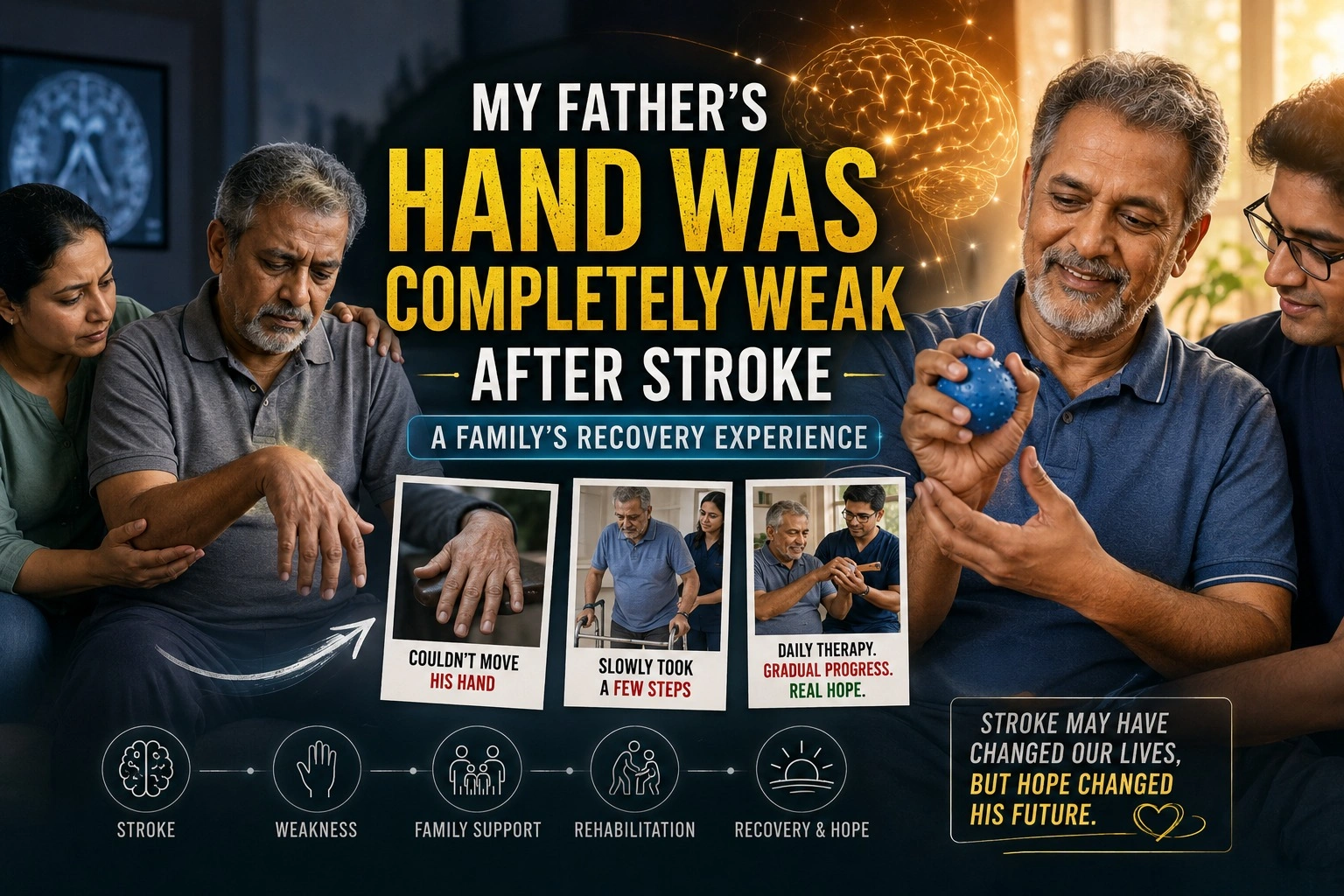
When my father suffered a stroke, our entire family’s life changed within a few minutes.
One side of his body became weak, but what affected him the most was his hand. He could slowly try to stand and take a few steps with support after a few weeks — but his hand remained almost completely non-functional.
He could not:
Hold a spoon properly
Button his shirt
Grip a glass of water
Write his name
Hold our hands firmly
For someone who had spent his whole life caring for our family independently, this was emotionally painful.
As a family, we initially believed that once walking improved, the hand would automatically recover too. But over time, we realized something important:
Hand Recovery After Stroke Is Much More Difficult Than Leg Recovery
Many stroke survivors regain some leg movement earlier because walking uses larger muscle groups and repetitive movement patterns.
But hand movement is different.
Simple activities like holding a cup or moving fingers require:
Precise brain signals
Fine motor coordination
Grip strength
Finger control
Muscle activation
Continuous brain-to-hand communication
This is why many stroke patients continue to struggle with hand weakness months or even years after stroke.
In fact, research shows that nearly 64–67% of stroke survivors continue to experience difficulty using the affected hand.
The Emotional Side of Hand Weakness After Stroke
People often talk about walking recovery after stroke.
But very few understand how emotionally difficult hand weakness can be.
My father became frustrated during simple daily activities:
Eating meals
Wearing clothes
Holding objects
Using his phone
Writing
Sometimes he would stop trying because he felt there was no improvement.
As family members, we also heard statements like:
“This may be the maximum recovery possible.”
That sentence can completely affect a patient’s motivation and confidence.
Why Traditional Exercises Alone May Not Be Enough
Initially, my father underwent regular physiotherapy sessions.
While they helped improve general movement and balance, hand recovery remained very slow.
The challenge with chronic stroke hand recovery is that the brain needs:
High repetition training
Active engagement
Functional movement retraining
Continuous stimulation
Repeating the same simple movements daily can sometimes become less effective over time, especially when patients lose motivation or the brain is not being sufficiently engaged.
That is when we started learning about advanced neuro rehabilitation approaches.
Understanding Neuroplasticity — The Brain’s Ability To Relearn
One of the most important things we learned during this journey was the concept of neuroplasticity.
Neuroplasticity means:
The brain’s ability to reorganize and create new pathways after injury.
Even after a stroke, the brain may still have the potential to relearn movements through repetitive, targeted rehabilitation.
This changed our entire perspective about recovery.
We realized recovery was not only about exercising muscles — it was also about retraining the brain.
How Advanced Hand Rehabilitation Helped My Father
During rehabilitation, the focus shifted toward:
Functional hand training
Repetitive movement therapy
Grip strength improvement
Finger movement exercises
Interactive rehabilitation methods
Brain-engagement-based recovery
Over time, we slowly started noticing small but meaningful changes.
First, he could slightly move his fingers.
Then he started gripping lightweight objects more confidently.
Eventually, simple activities like holding a spoon or cup became easier again.
For many people, these may seem like very small improvements.
But for stroke survivors and families, these moments are huge emotional victories.
Recovery Is Not Always Fast — But Progress Matters
One important lesson we learned is that stroke recovery is not linear.
Some days feel positive.
Some days feel frustrating.
But consistency matters.
Even small improvements in hand function can significantly improve:
Confidence
Independence
Daily activities
Emotional well-being
Quality of life
What Families Should Know About Hand Function Recovery After Stroke
If your loved one is struggling with:
Weak hand movement after stroke
Finger stiffness
Difficulty gripping objects
Poor coordination
Difficulty eating or writing
Chronic hand weakness months after stroke
Please know that recovery potential may still exist.
Early rehabilitation is important, but even chronic stroke patients can sometimes improve with targeted neuro rehabilitation programs.
Advanced Stroke Rehabilitation at ReWin Health
At ReWin Health, advanced stroke rehabilitation focuses on improving functional recovery through:
Physiotherapy
AI-Powered Rehabilitation
VR-Enabled Neuro Rehabilitation
Hand Function Recovery Programs
Motion Sensor-Based Training
Clinic Care & Home Care Support
The goal is not just movement recovery — but helping patients regain independence and confidence in daily life.
ReWin Health Clinics
Chennai
72, 28th Cross Street,
Indira Nagar, Adyar, Chennai – 600020, Tamil Nadu
Contact: +91 74488 22232
Puducherry
No.19, 3rd Main Road,
Navasakthi Nagar, Puducherry – 605009
Contact: +91 73388 22234
Thanjavur
No. 4, 6th Street,
Arulananda Nagar, Thanjavur – 613007, Tamil Nadu
Contact: +91 63851 88484
Take the First Step Toward Recovery
Understanding recovery potential early can help families make informed rehabilitation decisions.
Website: www.rewinhealth.com
About

Making Rehabilitation affordable, Accessible & Patient Centric for 2 Billion People