


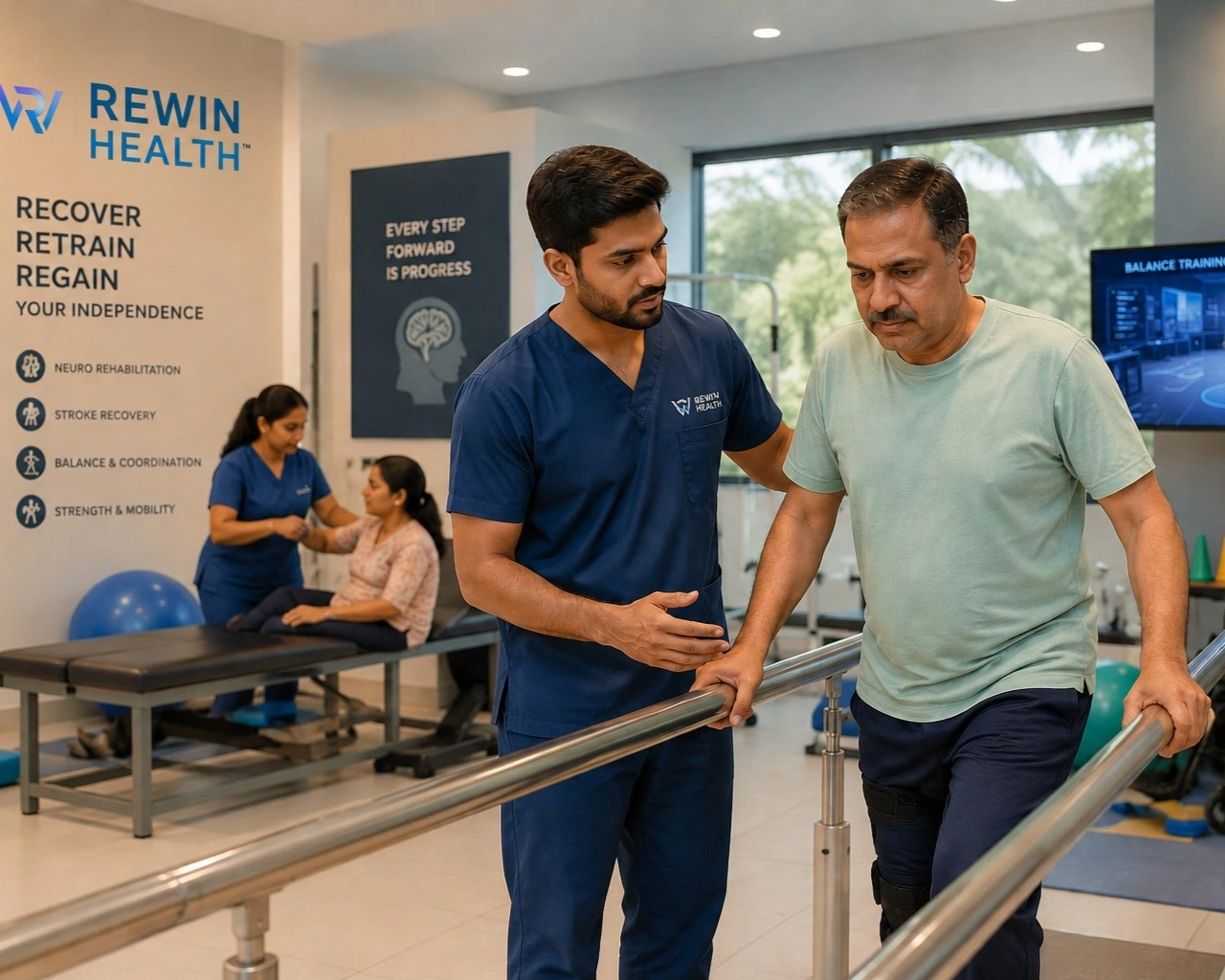
Structured. Technology-assisted. Proven outcomes for patients in week one and patients who have waited years.
Immersive Virtual Reality (VR) and
AI-Based Motion Sensor Technology
We treat stroke survivors at every stage of their journey. Whether your family member had a stroke last week or three years ago every patient begins with a structured programme built around the specific deficits their brain and body are facing. Not a generic protocol. A clinical plan, tracked at every session, adjusted as you progress. The same VR + AI platform trusted by NIMHANS, Apollo and MIOT now available directly to patients in Chennai, Thanjavur and Puducherry.
What our patients achieve in numbers
These are Rewin’s clinical outcomes across our stroke and neurological rehabilitation patient population. We share them because we believe you deserve to know what to expect from a programme before you commit to it
Reduction in depression & anxiety
Improvement in functional task
Patients treated at Rewin
90% of Rewin’s stroke patients achieve functional recovery of the upper limb. 95% Reduction in depression and Anxiety 50 to 55% rate. 90% rate their improvement in functional tasks. These are not aspirational targets – they are what our patient data consistently shows

How Rewin Health helped Padma Shri Bombay Jayashri recover from a brain aneurysm and return to performing Carnatic music.
Padma Shri and Sangeetha Kalanidhi awardee Bombay Jayashri — one of Tamil Nadu’s most celebrated Carnatic vocalists — suffered a life-threatening brain aneurysm. After emergency surgery in the UK, she returned to Chennai and chose Rewin Health for her rehabilitation.
Through Rewin’s structured VR-assisted stroke rehabilitation programme, she progressively rebuilt her ability to stand, walk, regain balance, and recover the motor function and coordination that Carnatic performance demands. Times of India documented her recovery as a landmark story in Indian rehabilitation medicine.
Her recovery is not an exception. It is what structured, technology-enabled stroke rehabilitation delivered with clinical rigour can achieve
Whether you had a stroke last week or last year – there is a programme for you.
Most rehabilitation services focus on the acute phase. Rewin treats the full continuum. If you are newly affected, we build momentum from day one. If you have been living with the effects of stroke for months or years and told further recovery is unlikely we want to have a conversation before you accept that
Build momentum from day one
The brain’s recovery response is most active in the first 3 months. Structured, intensive therapy in this window shapes how far you recover permanently. This is the moment not to wait
Our focus for you
- Walking and balance - from standing to stairs
- Arm and hand movement - reactivation from the first session
- Preventing learned non-use
- A 90-day recovery roadmap, built at your first assessment
- Family briefing - what to expect, how to support at home
Break through the plateau
Neuroplasticity does not stop at 6 months. What stops is the stimulus. Conventional physio, repeated at the same intensity for months or years, no longer challenges the brain enough. Rewin’s VR technology changes the stimulus fundamentally.
Our focus for you
- Breaking through the plateau with high-intensity VR
- Hand function recovery - including patients told it was no longer possible
- Gait improvement - walking quality, not just mobility
- Balance and fall prevention
- Reducing caregiver burden by increasing independence
Whether you had a stroke last week or last year – there is a programme for you.
Most rehabilitation services focus on the acute phase. Rewin treats the full continuum. If you are newly affected, we build momentum from day one. If you have been living with the effects of stroke for months or years and told further recovery is unlikely we want to have a conversation before you accept that
Build momentum from day one
The brain’s recovery response is most active in the first 3 months. Structured, intensive therapy in this window shapes how far you recover permanently. This is the moment not to wait
Our focus for you
- Walking and balance - from standing to stairs
- Arm and hand movement - reactivation from the first session
- Preventing learned non-use
- A 90-day recovery roadmap, built at your first assessment
- Family briefing - what to expect, how to support at home
Break through the plateau
Neuroplasticity does not stop at 6 months. What stops is the stimulus. Conventional physio, repeated at the same intensity for months or years, no longer challenges the brain enough. Rewin’s VR technology changes the stimulus fundamentally.
Our focus for you
- Breaking through the plateau with high-intensity VR
- Hand function recovery - including patients told it was no longer possible
- Gait improvement - walking quality, not just mobility
- Balance and fall prevention
- Reducing caregiver burden by increasing independence
Why patients come to Rewin when other clinics have not worked
What matters in stroke rehab
Conventional Physio
Rewin VR + AI + Physio
Movement repetitions per session
30–50
200–400
Real-time feedback to brain
Minimal
Immediate & precise
Individual limb & finger tracking
Not possible
AI sensor per digit
Multisensory stimulation
Single channel
Visual + motor + sensory
Patient engagement over time
Declines
Sustained – gamified
Adapts to patient progress
Manual, slow
Automatic each session
Upper limb functional recovery
Baseline
90% of patients
Improvement in functional task
Baseline
90% of patients
The gap in outcomes is not about effort or skill. A dedicated physiotherapist delivering conventional therapy is limited by what those tools can provide. Rewin’s technology removes the ceiling and our outcome data proves it
Neurological conditions treated at Rewin.
Stroke & Hemiplegia
Stroke affects every patient differently the area of the brain damaged determines what functions are affected. We treat all types and severity levels.
- Ischaemic and haemorrhagic stroke
- Hemiplegia and hemiparesis
- Upper limb rehabilitation - shoulder, arm, hand, fingers
- Lower limb rehabilitation - hip, knee, ankle, foot
- Gait retraining - from standing to walking to stairs
- Balance and postural control
- Spasticity management
- Post-stroke fatigue management
- Cognitive-motor dual task training
Parkinson’s Disease
Parkinson’s is progressive, but the rate of functional decline is not fixed. Rewin’s programme is specifically designed for this condition
- Balance training and fall prevention
- Gait retraining - reducing shuffling, festination, freezing
- Upper limb and hand exercises
- Dual-task training
- Postural stability and core activation
Traumatic Brain Injury (TBI)
TBI rehabilitation at Rewin is graduated and functional focused on safe, real-world independence alongside motor and balance recovery
- Post-concussion rehabilitation
- Motor recovery following moderate and severe TBI
- Balance and vestibular rehabilitation
- Upper limb and hand function retraining
Other Neurological Conditions
Programmes built around your specific deficits, not a generic protocol
- Post-brain surgery rehabilitation
- Multiple sclerosis - mobility and fatigue management
- Vertigo and vestibular disorders
- Spinal cord injury (outpatient appropriate)
What stroke does to the body and how rehabilitation addresses it
What happens in a stroke
A stroke occurs when blood supply to part of the brain is interrupted either through a blocked blood vessel (ischaemic stroke, ~80% of cases) or bleeding into the brain (haemorrhagic stroke). When this happens, brain cells in the affected area stop functioning. Because different regions of the brain control different functions, the effects of stroke depend entirely on where the damage occurs.
Neuroplasticity how the brain recovers
The brain has an extraordinary ability called neuroplasticity: the capacity to reorganise itself and create new neural pathways after injury. Following stroke, the brain can learn to route signals through undamaged areas if given the right stimulus.
The right stimulus means high-repetition, task-specific, feedback-rich movement practice. This is the scientific basis for why Rewin’s VR and sensor approach produces superior outcomes it delivers the stimulus that manual therapy alone cannot match at sufficient volume.
Motor effects
- Weakness of arm, leg, hand
- Difficulty walking
- Impaired balance
- Reduced coordination
- Spasticity and tightness
Sensory & cognitive
- Reduced sensation
- Altered body awareness
- Memory difficulties
- Reduced attention
- Impaired planning
Functional impact
- Dependence in daily activities
- Reduced mobility & independence
- Caregiver burden increases
- Reduced social participation
- Anxiety and depression
Right stimulus → Repeated movement practice → Brain adaptation → Functional recovery. Every element of the Rewin programme is designed around this pathway.
Why early rehabilitation matters and why late is still better than never
The first 3 months after stroke are when the brain’s recovery response is most active. Starting structured rehabilitation in this window consistently produces better long-term outcomes. This does not mean waiting is harmless every week of delay is a week without the stimulus the brain needs.
But and this is critical delayed rehabilitation is still far better than no rehabilitation. Neuroplasticity continues well beyond 3 months, 6 months, and 1 year. Patients at Rewin who are 2 and 3 years post-stroke continue to achieve new functional improvements with structured VR-assisted therapy. The ceiling most chronic patients have reached is not a neurological ceiling. It is a stimulus ceiling.
Recovery that changed lives in their own word
Meenakshi R, 48 · Chennai
Stroke, chronic phase
husband's recovery
Rajesh K, 54 · Thanjavur
Acute stroke
In-programme
Anitha S, 57 · Puducherry
Parkinson's disease
Fall prevention
What your stroke rehabilitation programme looks like at Rewin.
Free Assessment
45–60 min. Full evaluation: motor, sensory, balance, gait, hand function. No obligation
Honest Prognosis
Your therapist explains what the assessment shows and gives a realistic recovery trajectory
Programme Design
A session-by-session plan: frequency, milestones, technology mix, home exercise prescription
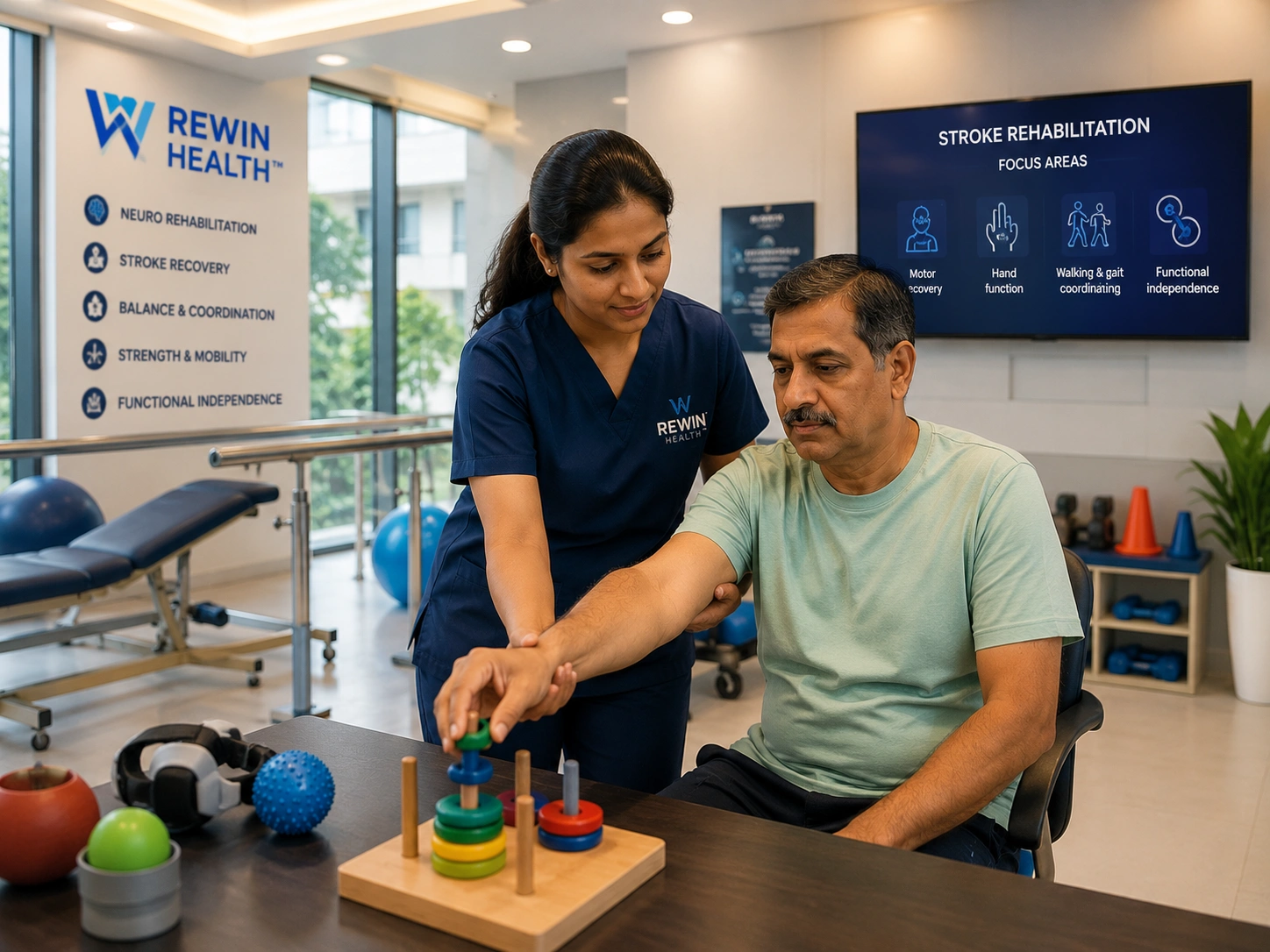
VR + Physio Sessions
Structured in-clinic sessions. VR platform combined with manual physiotherapy. Progress tracked every visit
Progress Reviews
Formal review every 2 weeks. Numbers, not impressions. Programme adjusted as you improve
Functional Recovery
Programme ends when you achieve your functional goals not at an arbitrary session count
45–60 minutes
Session length
3–5 sessions per week
Recommended frequency
3–6 months (condition-dependent)
Typical duration
After stroke, the hand is where most chronic patients get stuck and where most are told ‘this is as good as it gets.’
Rewin’s VR and sensor-based hand therapy is specifically designed for this. Using AI motion sensors that track individual finger movement, camera-based detection for patients with minimal residual movement, and gamified high-repetition exercises, we consistently achieve hand function improvement in patients who had plateaued or been told further recovery was impossible.
Our clinics across
South India
All Rewin clinics follow the same structured therapy protocol and use the same VR technology platform. The standard of care is identical whether you are in Chennai, Thanjavur, or Puducherry.
Chennai
- In-clinic physiotherapy
- Home visit service
- VR hand therapy
Mon–Sat | 9 AM – 7 PM
Thanjavur
- Structured stroke rehab
- VR hand therapy
- Orthopaedic & senior care
Mon–Sat 9 | AM – 6 PM
Puducherry
- Personalised physiotherapy
- Stroke & hand rehab
- Post-surgical recovery
Mon–Sat 9 | AM – 6 PM
Do not wait to see if more recovery happens on its own
Do not wait to see if more recovery happens on its own. It will not — not without structured stimulus. Every week that passes without the right rehabilitation is a week of neuroplastic window that does not come back.
And if your family member has been in conventional physiotherapy for months with no meaningful progress please speak to us before accepting the plateau as permanent. In our experience, it usually is not.
A free assessment costs nothing and commits you to nothing. It gives you a clear, honest picture of what structured VR-assisted rehabilitation can realistically achieve for your specific situation.
Chennai · Thanjavur · Puducherry
Chennai (city-wide)
Available nationwide
Honest answers to the questions families actually ask.
As soon as the patient is medically stable ideally within the first week. The brain’s recovery response is most active in the first 3 months, and structured therapy in this window permanently shapes the extent of recovery. Waiting to ‘see what recovers naturally’ is a choice with a cost every week without structured stimulus is a week the brain’s most responsive window is not being used.
Yes – and this is one of the most important things we want families to know. The plateau most chronic stroke patients experience is not a neurological ceiling. It is a stimulus ceiling. Conventional physio, delivered at the same intensity for months or years, no longer challenges the brain enough to generate new connections. Rewin’s VR-assisted programme provides a fundamentally different level of stimulus and our outcomes data shows that chronic patients, including those 2 and 3 years post-stroke, continue to achieve new functional improvement after starting a structured Rewin programme.
VR rehabilitation uses an immersive or screen-based environment to guide patients through structured exercises. It is not a game in the casual sense it is gamified therapy. The VR environment presents tasks that require specific movements. AI sensors track the patient’s actual movement and provide real-time feedback to the brain. The engagement keeps patients completing 200–400 repetitions per session four to eight times the repetition volume of conventional manual therapy. This repetition volume is what neuroplasticity recovery requires, and what conventional therapy cannot deliver at sufficient scale.
For patients in the acute and sub-acute phase, we recommend a minimum of 4–5 sessions per week. The brain’s recovery response requires frequent, consistent stimulus to maintain neuroplastic momentum. For chronic patients working on specific deficits, 3–4 sessions per week is typically appropriate. Your therapist will recommend a specific frequency at your free assessment based on your condition, your tolerance, and your goals.
Stroke is our primary specialisation. it represents the majority of our neurological patient population and is the condition our VR platform is most deeply optimised for. We also treat Parkinson’s disease, traumatic brain injury, post-brain surgery rehabilitation, and vestibular disorders. Our approach is the same: structured assessment, planned programme, measured outcomes.
Yes – from our Chennai clinic. A certified Rewin physiotherapist visits your home with the structured programme, and — for hand function patients — portable VR equipment where appropriate. Home visits are particularly valuable for stroke patients in early recovery who cannot safely travel, and for senior patients. WhatsApp us to confirm availability and pricing in your area. In Thanjavur and Puducherry, we recommend in-clinic attendance but can discuss options case by case.
Stroke is the 4th leading cause of death and the 5th leading cause of disability in India. It affects not only the patient but the entire family creating caregiver burden, reducing household income, and impacting improvement in functional task across the household. Structured rehabilitation does not just help the patient recover. It reduces long-term caregiver dependency, returns patients to social and family roles faster, and in many cases enables return to work. The investment in structured rehabilitation is almost always recovered many times over in reduced long-term dependency.